

Paris, but optional
Is Paris still essential to fashion success?

Have you ever noticed that different cities have a style identity? I grew up in the Bay Area and in Sacramento, and I remember San Francisco was all QZs and cargo pants and boots when I was young. Sacramento on the other hand was so hot, most people hardly cared about style (although I did go through a phase I can only call my California Farm Girl era—overalls, big hats and blue hair. I grew flowers too.).

Paris, on the other hand, has a totally different style identity. Most of us who move here come with our own hometown sense of style, or we overdo it and think that Paris has a super glamorous/red carpet style identity (it doesn’t by the way).
The longer we live here, the more Paris seems to creep into our closets. In my case, most things became black, more simple (I guess what people call elegant, which is really just minimalism), and even though I couldn’t quite let go of my bandit hats, I don’t wear them anymore.
As a fashion professor focused on Latin American and Indigenous fashion, my colleagues and I have deeply discussed how Paris fashion is seen as universal and all powerful, despite the fact that a) most Parisian fashion designers are not French, b) Paris is actually pretty international, and c) there are other systems of fashion on the rise.
So where does that leave Paris’ fashion identity as a city?
Most people know Paris is a city of fashion. But that would be an understatement. Paris is considered the home and origin point of what we consider “fashion.”
A (very) quick and (very) dirty history:
the first notion of stylistic difference happened in the 14th century in medieval Europe, primarily aristocratic men developing “legs” aka pants, and the beginning of sumptuary laws (only certain classes could wear certain fabrics, colors or even lengths).
In the 17thc. Louis XIV weaponizes fashion through governance and strategy to assert (perceived) power over his subjects and contemporaries (other kings).
In the 18thc. Marie Antoinette uses fashion as a token of power and expression of ideals. Most people believe her fashion spending crippled the French economy leading to the revolution, but there’s a lot more to that story.
In the 19thc. the first successful sewing machine is invented making the making of clothes easier and faster.
Also in the 19thc. Charles Frederick Worth, considered the father of haute couture, created most of the fashion models we still see today. Though English, he based his atelier in Paris, and voila…
Today Paris is the most powerful, most resourced, most governed ecosystems of fashion. Fashion represents roughly 3% of France’s GDP, making it one of the country’s major economic sectors, with a huge influence relative to its size. What makes fashion powerful in Paris though is not necessarily how much money it makes the country (€150B), but the influence of its identity as globally luxury dominant (a physical reality), and its cultural positioning in France (a believed reality).
But despite those real and perceived ideas of fashion in Paris, we can see cracks in the system. Giambattista Valli cancelled both Haute Couture and FW26 Ready-to-Wear (twice in one season) due to financial issues.
Other designers are stepping back from the calendar altogether. Some, like Coperni and Sacai, are skipping seasons or shifting formats, while others are choosing to show elsewhere—Valentino in Rome, Thom Browne in San Francisco, Maison Margiela in Shanghai.
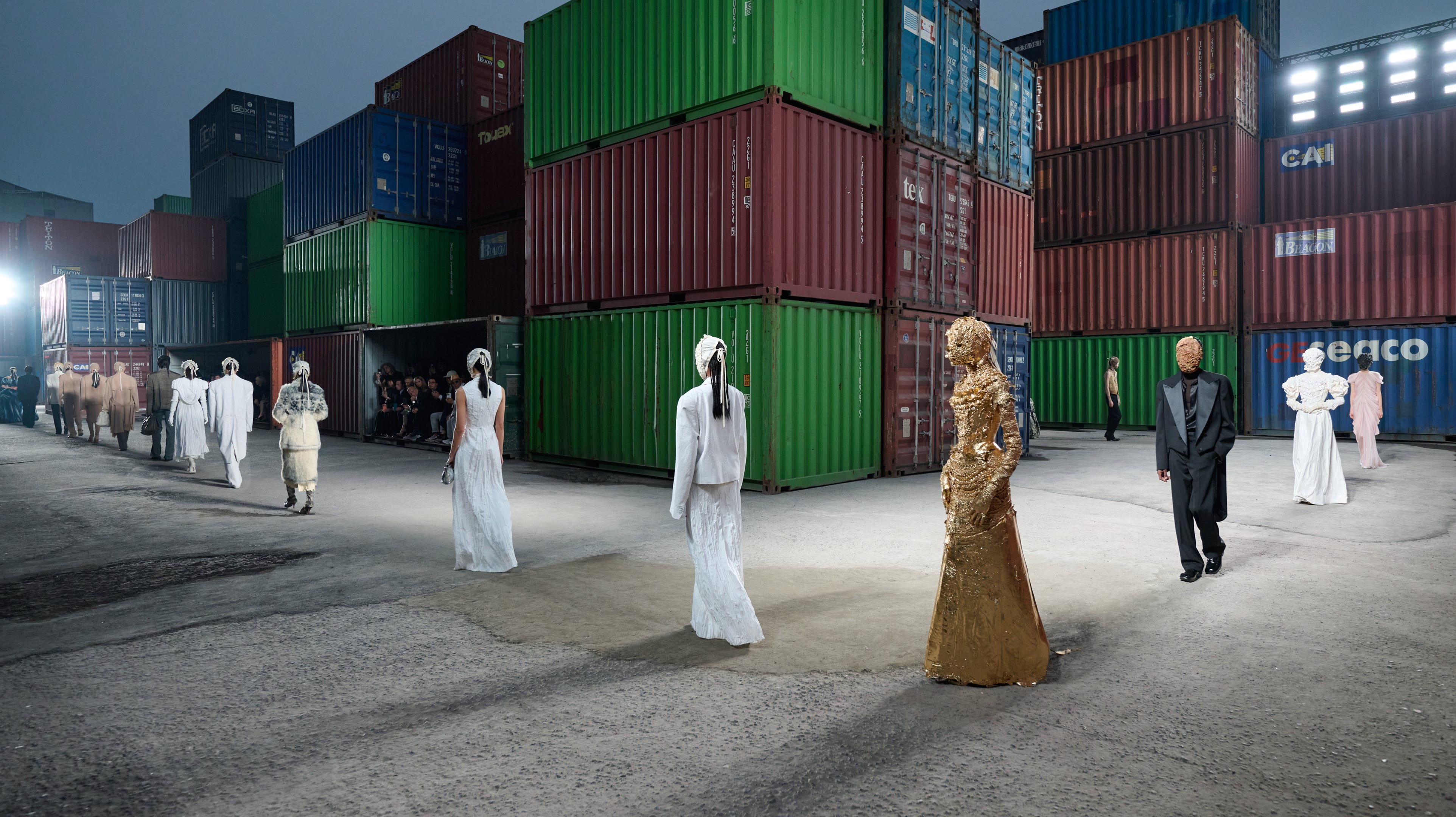
This is a breakdown of the traditional calendar, where showing in Paris is no longer an obligation but a strategic choice.
That is not a minor shift.
For over a century, Paris functioned as a kind of structural requirement. If you wanted legitimacy, you showed here. The system was centralized, and Paris sat firmly on the top.
But when designers can skip, relocate, or step outside the calendar entirely, it feels like Paris is now something that brands opt into, rather than depend on.
That changes the role Paris has been playing.
Though I don’t think that Paris as the center of fashion is disappearing anytime soon, its authority no longer feels unquestioned. Instead it has to continually assert its power in as many ways as possible.

Looking at Paris Fashion Week itself, what comes through is not experimentation, but control. Designers leaned heavily into structure, material, and a deep demonstration of savoir-faire.* At Dior, the emphasis was on precision and authorship—clothes that assert a clear point of view and technical mastery. At Chanel, the response was immediate and commercial, with products moving quickly and stores filling in ways they haven’t in years.
These shows do more than present clothes. They reinforce belief and positioning. Belief in craft, in heritage, in Paris as the place where fashion reaches its highest form and still controls the market.
When people say that fashion doesn’t matter, they are wrong. Paris fashion does not just produce something beautiful that you put on your body. It produces global power.
And right now, it feels like that power is being actively maintained, not given.
*I came to these conclusions after analyzing and coding 700 looks across the four fashion capitals—300 of which were from Paris.
Thank you for staying after class.